Friday, February 22, 2013

Geologic Time Scale

Directions for Adding Machine Paper Geologic Time Scale

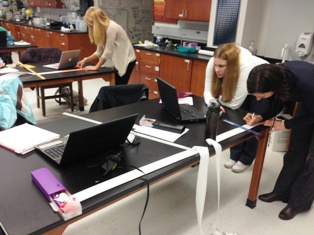
The purpose of this activity is to give a graphic demonstration of the enormous extent of geologic time compared to recent time. Using the events listed below, construct a linear representation of Geologic Time by taking your group’s roll of adding machine paper and make a Geologic Timeline.
Directions: 1. Decide what scale you will use and record that at the beginning of your tape. You will use meters, centimeters and millimeters to represent units of time in the history of the earth.

a. If 46 meters represents 4.6 billion years, how many years does 1 m represent? ____________

b. How many years are represented by 1 cm? __________________ 10 cm? _____________

c. How many years are represented by 1 mm? _________________

2. Using your meter stick, mark off increments of a billion years along the bottom of the tape until you get to the “origin of Earth” at 46 billion years. Give yourself a little room past this mark to write on and cut your tape.

3. First, record the eras, periods and epochs along the bottom of the tape. You may want to use different colors of pencils to make it visually stand out and look attractive.


Wednesday, February 13, 2013

MIX DRY Rockets, NASA rockets

[PDF]

Pop! Rocket Launcher - Nasa

www.nasa.gov/.../295790main_Rockets_Pop_Rocket_Launch...SimilarShare
Shared on Google+. View the post.
File Format: PDF/Adobe Acrobat - Quick View
Ruler. Optional: PVC cutter. Eye protection for anyone near launcher. Management. The Pop! Rocket Launcher, although fun for all students, is an ideal launcher ...

[PDF]

Advanced High-Power Paper Rockets - Nasa

www.nasa.gov/.../295786main_Rockets_Adv_High_Power_Pa...Share
Shared on Google+. View the post.
File Format: PDF/Adobe Acrobat - Quick View
1/2” PVC pipe 24” long for each rocket builder or team. Eye protection. Mission Report sheet. Other construction materials as required by the team missions ...

[PDF]

Water Rocket Construction - Nasa

www.nasa.gov/.../153406main_Rockets_Water_Rocket_Const...SimilarShare
Shared on Google+. View the post.
File Format: PDF/Adobe Acrobat - Quick View
The cuts can be slanted to streamline them. A saw or PVC cutter is used for cutting. The segments act as launch lugs to guide the rocket up the launch rod during ...

[PDF]

Rockets Educator Guide - Nasa

www.nasa.gov/.../153402main_Rockets_Launch_Altitude_Tra...SimilarShare
Shared on Google+. View the post.
File Format: PDF/Adobe Acrobat - Quick View
the altitude achieved by the rockets they construct. Description. Determining the altitude reached by a rocket ... Join the PVC pieces together as shown in ...

[PDF]

How in the world did they do it - Steve Spangler Science

File Format: PDF/Adobe Acrobat - Quick View
By Gregory Voght/NASA JSC ... Students construct paper rockets, test rocket stability, and launch with an air ... Rocket forms (short lengths of ½ “ PVC tubes) ...

PVC Rocket Launcher - Rocket Boys Curriculum

Rocket Launchers and More - A New Lesson in Rocketry Adapted from “Industrial Strength Paper Rockets” By Gregory Voght/NASA JSC. How to Make PVC ...

MAKE | How-To Tuesday: Compressed air rocket

Mar 10, 2009 – At normal temperatures, standard Schedule 40 PVC has a working ... NASA's description of how air-powered rockets work also includes a nice ... 


Friday, February 8, 2013

Astronomy: Constellations and Stars

http://www.lawrencehallofscience.org/starclock/skywheel.html

http://www.exploratorium.edu/eclipse/how.html 


This is probably the most important part of this website. If you ever want to view an eclipse, the first thing you must know is this:Never view the sun with the naked eye or with any optical device, such as binoculars or a telescope!This is more than advice. Why? As a kid, did you ever take a magnifying glass out into the sun and burn leaves? If so, you probably remember that when the focused sunlight coming through the lens was refracted and concentrated to a small spot, the energy available there was truly remarkable. Guess what? You have a lens just like that in your eye. If you look at the sun, your eye-lens will concentrate the sun's light and focus it to a very small spot on the back of your retina. This can cause permanent eye damage or blindness. Additionally, there are no pain sensors back there so you won't even know it's happening! Have I scared the willies out of you? Good!

Thursday, February 7, 2013


EXPERIMENTAL VARIABLES: What in the World Are Variables?

In science a variable can be anything. More specifically, in an experiment or test, a variable can cause something to change, be the result of something that changed, or be controlled so it has no effect on anything.

Variables that cause something to change are called
independent variable or manipulated variables. Whether you choose to call it an independent variable or a manipulated variable depends on the term you pair it with. The acronym MIX DRY can help you keep these paired terms straight.

Manipulated Independent X-axis

Dependent Respodning Y-axis


Variables that are the result of something that changed are called dep
endent variable or responding variables. Again, the term you choose to use depends on how you pair the words.

Variables can sometimes affect an experiment when you do not want them to. In order for you to conduct a proper investigation, you have to set up the right environment that is as controlled as possible. You need to make sure that you control the effects of as many factors, or variables, as you can so that you can prove your hypothesis. Some of these variables will stay the same throughout the whole investigation. These are the
controlled or constant variables.
They do not get to play along in the experiment, even though they may be indirectly part of it.

Since variables are necessary for an experiment, you need to make sure they are properly identified. By the time you have arrived at your hypothesis, you have a pretty good idea of what you are trying to prove. Hypotheses are usually written in "if-then" format or “what is the effect of X on Y” because these are a great way to make sure your "
Hypothesis" is specific to what you are going to test.


Tuesday, February 5, 2013

Measuring Sun Angles

http://mysite.du.edu/~jcalvert/astro/gnomon.htm 

The gnomon is a scientific instrument that can be used for finding the declination of the sun through the year, among other things. It is one of the first scientific instruments ever made, originating with the Chaldean astronomers of Babylon and from there brought to the Greek world. It is still very instructive, an excellent example of random and systematic errors of measurement, vividly demonstrating astronomical principles. The Greek gnwmwn, originally meaning one who knows, or judge, was also used for the index of a sundial, as well as for the carpenter's square. It is easy to make a good portable gnomon, and easy to use it.

Practical Application: http://www.builditsolar.com/SiteSurvey/site_survey.htm


Friday, February 1, 2013