Sunday, March 22, 2015

Form and Function


Charles Darwin observed in his journal that finches living on different Galapagos Islands had different beaks. He also observed that the environment on each of four islands was quite different from the environment on the other three islands; in particular, the type of food available to the finches was different on each island. He developed an hypothesis that the finches had all been the same at one time, (probably blown over from the coast of South America), with some variations in their beaks which made some beak types better adapted to the food on each island and so the birds with those beaks survived and reproduced and the others did not on that particular island with its particular type of food.These are an example of four different types of beaks found in finches living in the four different islands.

http://www.stem.neu.edu/programs/re-seed/activities-and-labs/natural-selection-bird-beak/  


Friday, February 6, 2015

The Sun King and Solar System Sizes


Make a scale model of the Solar System and learn the REAL definition of "space."
This Page requires a JavaScript capable browser.


Data from Journey through the Universe and the Exploratorium


Lunar Measurements and Impact Crators

Journey to the Universe: Lesson Plans and Activities


Making Craters (DRY MIX) http://teachers.greenville.k12.sc.us/sites/mdacko/Pages/DRY%20MIX%20and%20Graphing.aspx


The circular features so obvious on the Moon’s surface are impact craters formed when impactors smashed into the surface. The explosion and excavation of materials at the impacted site created piles of rock (called ejecta) around the circular hole as well as bright streaks of target material (called rays) thrown for great distances.
http://www.nasa.gov/pdf/180572main_ETM.Impact.Craters.pdf 
http://www.teach-nology.com/teachers/lesson_plans/science/68moon.html


Friday, January 23, 2015

STEM to STEAM

What is STEAM?


In this climate of economic uncertainty, America is once again turning to innovation as the way to ensure a prosperous future. Yet innovation remains tightly coupled with Science, Technology, Engineering and Math – the STEM subjects. Art + Design are poised to transform our economy in the 21st century just as science and technology did in the last century. We need to add Art + Design to the equation — to transform STEM into STEAM.
http://stemtosteam.org/


Measurement

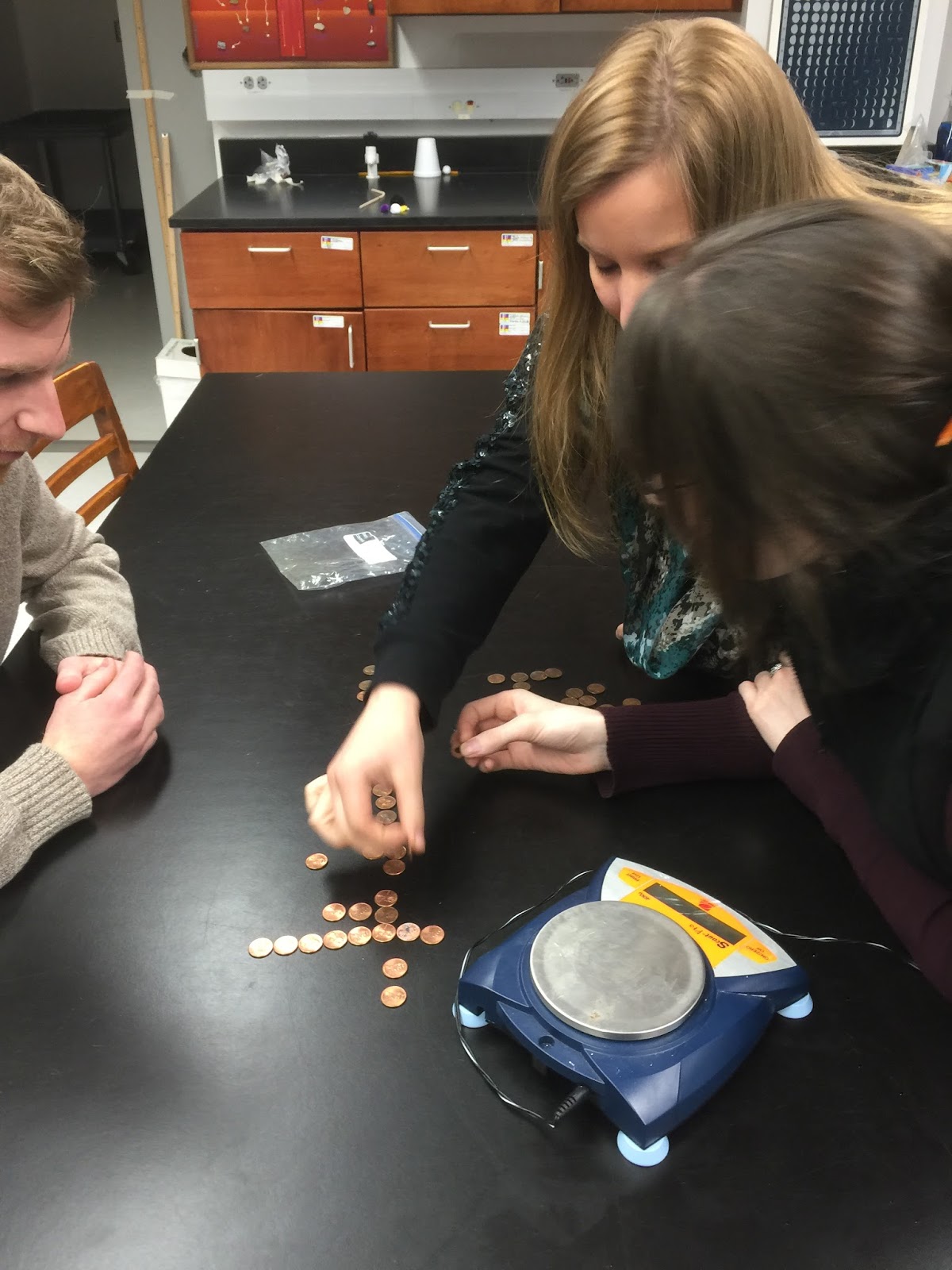
Earth’s gravity pulls on all objects. Near the surface of the earth, the acceleration of all objects due to gravity is the same. Drop a penny and a pen from the same height and they will hit the ground at the same time. When objects travel down an inclined plane, gravity is pulling them downward, but the plane is exerting a force on the object, which makes it fall along the plane rather than straight down. Two marbles, regardless of size, will accelerate at the same rate. The two marbles should reach the bottom of the plane at the same time.

Thursday, January 15, 2015

MSED 340

Using Engineering Principles

The fields of science and engineering are mutually supportive. New technologies expand the reach of science, allowing the study of realms previously inaccessible to investigation; scientists depend on the work of engineers to produce the instruments and computational tools they need to conduct research. Engineers in turn depend on the work of scientists to understand how different technologies work so they can be improved; scientific discoveries are exploited to create new technologies in the first place. Scientists and engineers often work together in teams, especially in new fields, such as nanotechnology or synthetic biology that blur the lines between science and engineering. Students should come to understand these interactions and at increasing levels of sophistication as they mature. Their appreciation of the interface of science, engineering, and society should give them deeper insights into local, national, and global issues. (NGSS)


Understanding the Nature of Scientific Literacy
 SCIENTIFIC INQUIRY
Fundamentally, the various scientific disciplines are alike in their reliance on evidence, the use of hypothesis and theories, the kinds of logic used, and much more. Nevertheless, scientists differ greatly from one another in their recourse to fundamental principles; and in how much they draw on the findings of other sciences.

There are, however, certain features of science that give it a distinctive character as a mode of inquiry. Although those features are especially characteristic of the work of professional scientists, everyone can exercise them in thinking scientifically about many matters of interest in everyday life.